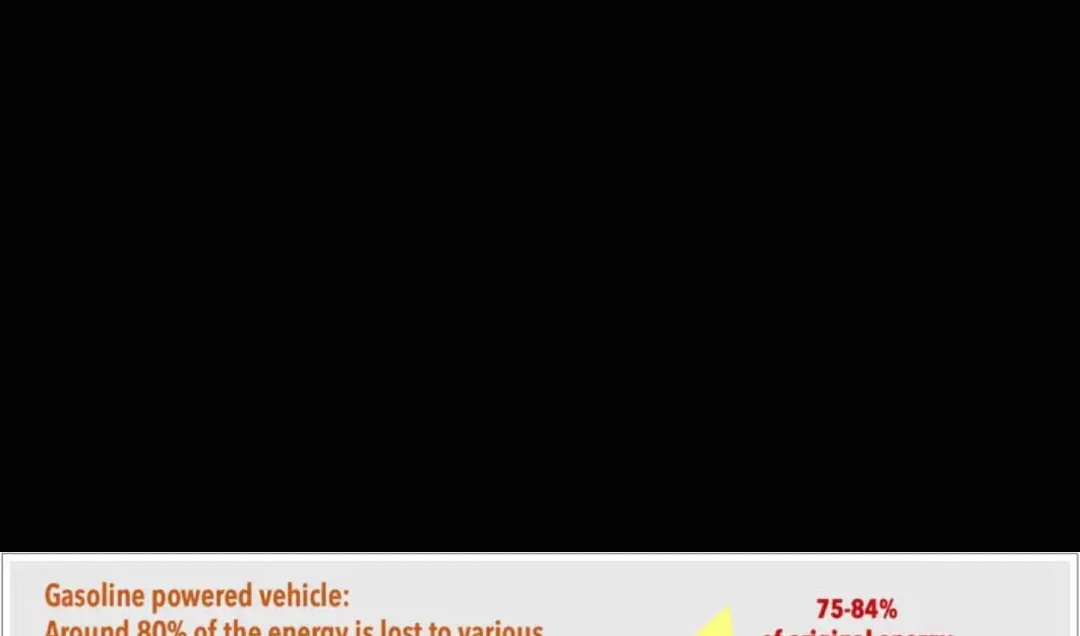
Data from FuelEconomy.gov. Graphic by Karin Kirk for Yale Climate Connections. The original article is available here: (https://yaleclimateconnections.org/2024/01/electric-vehicles-use-half-the-energy-of-gas-powered-vehicles/)
The graphic above makes a striking comparison.
In a gasoline-powered vehicle, only about 16–25% of the energy stored in the fuel ultimately reaches the wheels. Most of it leaves the vehicle as engine heat and other losses. In an electric vehicle, the drivetrain is dramatically more efficient, and regenerative braking can recover some of the energy that would otherwise be lost. DOE describes a typical EV as roughly 87–91% efficient after accounting for regenerative braking.
But there is an important detail hidden in that picture:
The energy story didn't actually start at the gas tank or the battery.
Gasoline first had to be extracted as petroleum, transported, refined, and delivered to a filling station. Electricity had to be generated somewhere and moved through the electric grid to the charger. Those are commonly called the upstream portions of the energy system.
That means there is no single universal upstream number for an EV. Electricity in one community may come from a different combination of natural gas, nuclear, solar, wind, hydro, and other sources than electricity somewhere else. EPA's Power Profiler lets consumers enter a ZIP code and see the generation mix and emissions associated with electricity in their region.
And EVs certainly aren't impact-free. Batteries have to be manufactured, electricity has to be produced, and the vehicle itself has to be built. That's why researchers at Argonne National Laboratory developed the GREET model to examine the whole lifecycle, rather than stopping at the vehicle. DOE's current analysis estimates that a representative 2025 battery-electric SUV using the average U.S. grid produces about 46% less lifecycle greenhouse-gas emissions than a comparable gasoline vehicle, including vehicle production, battery production, fuel production, and vehicle operation.
What Does Any of That Have to Do With Your House?
Quite a lot.
Homes are also energy systems. We tend to think about individual pieces, the furnace, air conditioner, water heater, insulation, electrical panel, or solar panels, when what ultimately matters is how all of those pieces work together.
A well-insulated and air-sealed house needs less heating and cooling in the first place. A properly designed heat pump can then provide heating and cooling without burning fuel at the house. A heat-pump water heater can do something similar for domestic hot water. Solar can supply some of the electricity those systems consume.
The goal isn't simply to replace one fuel with another.
It is to use less purchased energy to provide the comfort, hot water, transportation, and other services that you actually want.
That lesson applies whether your household has received energy assistance through a weatherization program or you've invested your own money in efficiency, HVAC, or solar.
Before You Replace That Furnace or Water Heater, Look at the Whole House Again
If it has been several years since your last home energy audit, this can be a particularly good time for an update.
Your house may not have changed much, but the technology and the economics around it have.
An updated energy audit can help determine how much heating and cooling the house actually needs, whether insulation or air-sealing work should come first, how the existing duct system is performing, whether electrical upgrades may be necessary, and which equipment makes sense before you commit to a replacement.
It can also uncover something that has become increasingly important:
Rebates and incentives.
After working with energy-efficiency programs for many years, we've learned a simple lesson: take advantage of good rebates while they are available.
Program budgets change. Eligibility rules change. Utility territories matter. Income qualifications matter. Equipment requirements and deadlines change. A rebate that makes a project particularly attractive today should not automatically be assumed to exist when the equipment finally fails two years from now.
And right now, the programs are quite different depending on where you live.
DC has active incentives that specifically provide additional support for some gas-to-electric heat-pump conversions, as well as qualifying electrical-panel and circuit work associated with electrification. Maryland has heat-pump incentives through participating EmPOWER Maryland utilities and separate programs for income-qualified households. Virginia's state-administered federal Home Energy Rebate programs are still being developed as of September 2026, while other utility and local incentives may already be available.
That's one reason we recommend checking the current incentives before buying the equipment, rather than trying to figure them out after the installation.
Sometimes "Replace the Furnace" Involves Four Different Trades
Electrification can sound deceptively simple.
Take out a gas furnace. Put in a heat pump.
But depending on the house and the jurisdiction, that project may involve HVAC work, electrical circuits or a panel upgrade, gas fitting to properly abandon or reconfigure the old fuel piping, and sometimes plumbing as well. A gas water-heater conversion can similarly cross several trades.
That coordination has become an important part of EDGE Energy's approach. Our HVAC division performs heat-pump conversions, backed by our electrical, plumbing, gas-fitting, and home-performance teams in-house.
Instead of treating each piece of the house as a separate project, we can look at the building as a system and help determine what actually needs to change, and what doesn't.
Start With the House You've Already Got
You don't need an EV, solar panels, or a major renovation to benefit from this way of thinking.
Some of our customers first met EDGE through a low-income weatherization program. Others hired us for a home energy audit. Some purchased solar systems. Others simply called when an air conditioner or furnace needed replacement.
The physics is the same for everyone:
Reduce the energy that gets wasted. Use efficient equipment to do the work that remains. Then make the energy you still need as affordable and clean as practical.
If your furnace, boiler, air conditioner, or water heater is getting older, or your last energy audit is several years old, this may be a good time to revisit the plan before something breaks.
Contact EDGE Energy for an updated home energy audit or a review of your heating, cooling, hot-water, and electrification options. We can also help identify the current rebates available at your address in Virginia, Maryland, or DC before you decide what to install.
Want to Dig Deeper?
For consumers who want to explore the underlying numbers and available programs:
- DOE: [How efficiently EVs and gasoline vehicles use energy] (https://www.energy.gov/cmei/vehicles/articles/fotw-1360-sept-16-2024-typical-ev-87-91-efficient-compared-30-conventional)
- DOE/Argonne: [GREET lifecycle energy and emissions model] (https://www.energy.gov/cmei/greet)
- EPA Power Profiler: [See how electricity is generated in your area] (https://www.epa.gov/egrid/power-profiler)
- ENERGY STAR: [Find rebates and incentives by ZIP code] (https://www.energystar.gov/saveathome)
- DC Sustainable Energy Utility: [Residential heating and cooling rebates] (https://www.dcseu.com/residential-rebates/heating-cooling)
- Maryland Energy Administration: [Heat-pump programs and incentives] (https://energy.maryland.gov/residential/pages/technicalassistance/heatpump.aspx)
- Virginia Energy: [Current status of Home Energy Rebates] (https://www.energy.virginia.gov/energy-efficiency/HomeEnergyRebatesFrequentlyAskedQuestions.shtml)

Garrett Spangler writes about home energy, electrification, and the renewable industry for The EDGE Journal.
Questions about this article?
Fill out the form and our team will get back to you shortly.