Part 1 of EDGE Energy's Three-Part Emergency Preparedness Series
You don't need to spend thousands of dollars on a whole-home backup system to prepare for an extended power outage. With the right equipment, realistic expectations, and a little planning, homeowners can protect their most essential electricity needs for under $1,500.
Power outages are becoming an increasingly important concern for homeowners throughout Maryland, Washington, DC, and Northern Virginia.
Whether caused by severe winter weather, summer storms, fallen trees, or unexpected grid disruptions, losing electricity for several days can quickly become more than an inconvenience.
Refrigerators stop cooling, phones run out of battery, internet connections disappear, and everyday household activities become difficult.
The good news? You can build a practical emergency backup power setup for under $1,500.
The key is understanding what you actually need to power, choosing equipment that can support those needs, and preparing before an outage occurs.
In this first article of our three-part series, EDGE Energy explains how to evaluate your electricity needs, compare affordable backup power options, and build a realistic emergency preparedness budget.
1. Start With What You Actually Need to Power
Before purchasing a generator, battery, or portable solar panel, ask yourself one question:
What absolutely needs electricity if my home loses power for seven days?
For most households, the priority isn't keeping every appliance running. It's maintaining a few essential functions.
These might include:
- Refrigerator or freezer: Protecting food and refrigerated medications.
- Phones and communication devices: Staying connected to family, emergency services, and weather updates.
- LED lighting: Safely navigating your home after dark.
- Internet equipment: Maintaining communication when local service remains available.
- Medical equipment: Supporting devices that require electricity.
- Small electronics: Charging laptops, radios, and other essential devices.
Larger appliances such as electric ovens, clothes dryers, water heaters, and electric space heaters generally require substantially more electricity.
For example, a typical electric space heater operating at 1,500 watts could consume the entire usable capacity of a 1,000-watt-hour portable battery in less than an hour.
The goal isn't to power your entire home. It's to keep your most important equipment operating as efficiently as possible.
Important: Households relying on electrically powered medical equipment should establish a separate emergency plan with their equipment provider and healthcare team. A budget backup system may not provide sufficient reliability.
2. Understand Watts, Watt-Hours, and Battery Capacity
You don't need to be an electrician to understand the basics of backup power.
However, knowing a few terms can prevent expensive purchasing mistakes.
Watts (W): How Much Electricity an Appliance Uses
Watts measure the rate at which an appliance consumes electricity.
For example:
| Appliance | Approximate Running Wattage |
|---|---|
| LED light bulb | 5–12 W |
| Wi-Fi router | 10–20 W |
| Laptop | 30–100 W |
| Refrigerator | 100–250 W while running |
| Electric space heater | 1,500 W |
These are illustrative ranges. Actual consumption varies by appliance, operating conditions, and model.
Some appliances, particularly refrigerators and other motor-driven equipment, also require a brief surge of additional electricity when starting.
Your backup equipment must accommodate both the normal operating load and any required startup surge.
Watt-Hours (Wh): How Much Energy You Need
Watt-hours measure energy consumption over time.
For example:
A 100-watt appliance operating continuously for five hours consumes approximately:
100 watts × 5 hours = 500 watt-hours (Wh)
A portable battery rated for 1,000 Wh does not necessarily deliver 1,000 Wh of usable AC electricity. Some energy is lost through its inverter and other internal systems.
This is why battery capacity, appliance runtime, and charging opportunities all matter.
A Simple Household Example
Consider a homeowner who wants to operate the following equipment:
| Equipment | Estimated Daily Energy Use |
|---|---|
| Refrigerator | 1,000 Wh |
| LED lighting | 100 Wh |
| Phones and small electronics | 100 Wh |
| Wi-Fi router | 240 Wh |
| Total | 1,440 Wh/day |
This household would require approximately 1.44 kilowatt-hours (kWh) of electricity per day before accounting for additional conversion and charging losses.
Over seven days, that represents approximately 10 kWh of energy.
Purchasing a battery large enough to store all that electricity would likely exceed our $1,500 budget.
Instead, homeowners should consider equipment that can be recharged throughout the outage.
That brings us to three practical backup power options.
3. Option A: Portable Battery and Solar Panels
Best for: Homeowners who prioritize quiet operation, indoor battery use, and the ability to recharge using sunlight.
Portable power stations, often marketed as solar generators, are rechargeable batteries with built-in electrical outlets.
They can power compatible appliances and electronics without producing combustion exhaust.
When paired with portable solar panels, they can recharge during daylight hours.
Advantages
- Quiet operation.
- No gasoline or propane required.
- Suitable for indoor use when operated according to manufacturer instructions.
- Can recharge from compatible solar panels.
- Relatively simple to operate.
- Useful for phones, lighting, laptops, and selected small appliances.
Limitations
- Limited battery capacity.
- Solar charging depends on available sunlight.
- Cloudy winter weather can significantly reduce charging.
- Larger appliances can drain batteries quickly.
- Portable solar panels require appropriate placement and compatible connections.
Example Budget: Battery and Solar Setup
| Equipment | Estimated Cost |
|---|---|
| Portable power station, approximately 1,000 Wh | $500 |
| Compatible portable solar panels, approximately 200 W total | $350 |
| Properly rated solar extension cables and accessories | $100 |
| Rechargeable LED lighting | $50 |
| Emergency weather radio | $40 |
| Backup charging cables and small accessories | $60 |
| Battery-powered carbon monoxide/smoke safety equipment, as needed | $60 |
| Emergency supplies and contingency allowance | $140 |
| Estimated Total | $1,300 |
Prices are illustrative budget targets, not confirmed offers. Actual costs vary by manufacturer, equipment specifications, and availability.
This configuration leaves approximately $200 below our $1,500 ceiling.
However, there is an important limitation.
A 200-watt solar array does not continuously produce 200 watts throughout the day.
Sun angle, shading, clouds, temperature, and charging losses all affect production.
During poor weather, the system may produce substantially less electricity than the household consumes.
A solar generator is only as useful as its battery capacity, charging capability, and the sunlight available when you need it.
Homeowners should practice using their solar equipment before relying on it during an emergency.
We'll cover solar panel positioning, cable sizing, series and parallel connections, and equipment testing in Part 2.
4. Option B: A Small Dual-Fuel Generator
Best for: Homeowners who need to operate refrigeration and other essential appliances for longer periods and have a safe outdoor location for generator operation.
Small inverter generators can provide a practical alternative to battery-only backup systems.
Unlike portable batteries, fuel-powered generators produce electricity while operating, provided sufficient fuel is available.
Many models can operate on gasoline, propane, or both.
Why Consider a Dual-Fuel Generator?
A dual-fuel generator provides the flexibility to operate using either gasoline or propane.
For homeowners planning to use a generator primarily for emergencies, propane offers several advantages.
Propane can simplify long-term preparedness because it does not deteriorate in storage the same way gasoline does.
Operating a dual-fuel generator exclusively on propane can also help avoid stale gasoline and fuel-system problems associated with gasoline storage.
However, propane-powered generators still require regular maintenance, and their electrical output may be lower when operating on propane.
For example, one 2,000-watt dual-fuel inverter generator from Champion is rated for 1,700 running watts on gasoline but 1,530 running watts on propane.
Homeowners should always size their equipment using the manufacturer's specifications for their intended fuel.
Example Budget: Dual-Fuel Generator Setup
| Equipment | Estimated Cost |
|---|---|
| Small dual-fuel inverter generator | $650 |
| Two 20-pound propane cylinders, filled | $140 |
| Properly rated outdoor extension cords | $150 |
| Manufacturer-approved generator weather protection | $150 |
| Battery-powered carbon monoxide alarms | $60 |
| Rechargeable lighting and emergency radio | $90 |
| Backup cables and miscellaneous accessories | $60 |
| Additional emergency supplies | $100 |
| Estimated Total | $1,400 |
These are illustrative cost allowances. Actual generator prices, propane costs, and approved weather-protection options must be verified for the selected model.
How Long Will the Propane Last?
That depends on the generator, electrical load, and operating conditions.
Some small inverter generators advertise runtimes exceeding 20 hours on a 20-pound propane cylinder under relatively light loads.
However, homeowners should not assume those runtimes apply when powering multiple appliances.
A generator running continuously for seven days would require 168 hours of operation.
Two propane cylinders would not necessarily provide enough fuel for that duration.
For a seven-day outage, fuel planning is just as important as generator sizing.
Homeowners may need to operate equipment selectively, maintain additional fuel supplies, or arrange safe refueling opportunities.
Critical Generator Safety
Gasoline and propane generators produce carbon monoxide, a potentially deadly gas.
Never operate a fuel-powered generator inside a home, garage, basement, shed, or other enclosed or partially enclosed space.
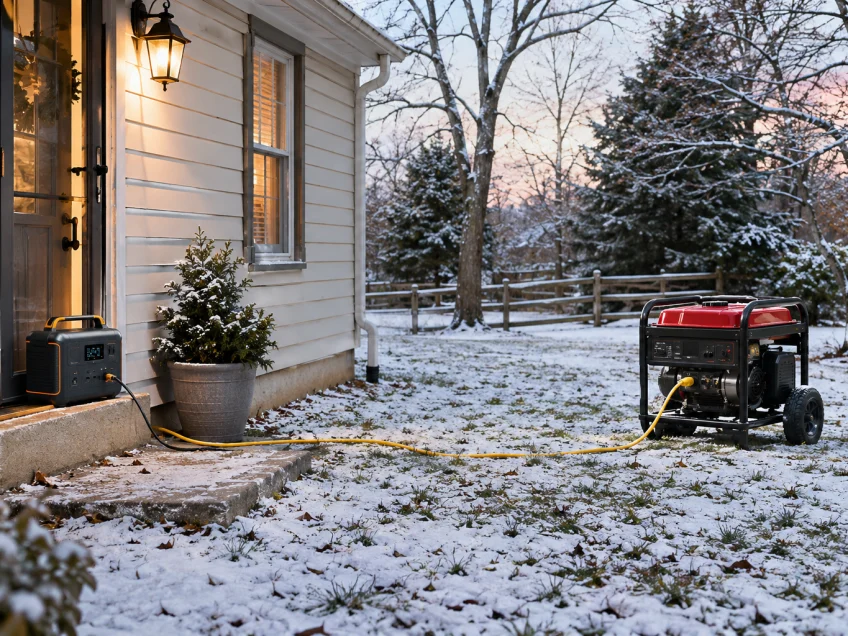
The Consumer Product Safety Commission recommends operating portable generators outdoors, at least 20 feet from the home, with exhaust directed away from windows, doors, and vents.
Generators must also be protected from unsafe wet-weather conditions according to their manufacturer's instructions.
Never connect a portable generator directly to household wiring through a wall outlet.
Doing so can create dangerous backfeeding conditions. Supplying household circuits requires properly installed, code-compliant transfer equipment.
We will cover generator placement, weather protection, electrical connections, and carbon monoxide safety in detail in Part 3.
5. Option C: A Hybrid Battery and Generator Setup
Best for: Homeowners who want the flexibility of portable battery power combined with fuel-based recharging.
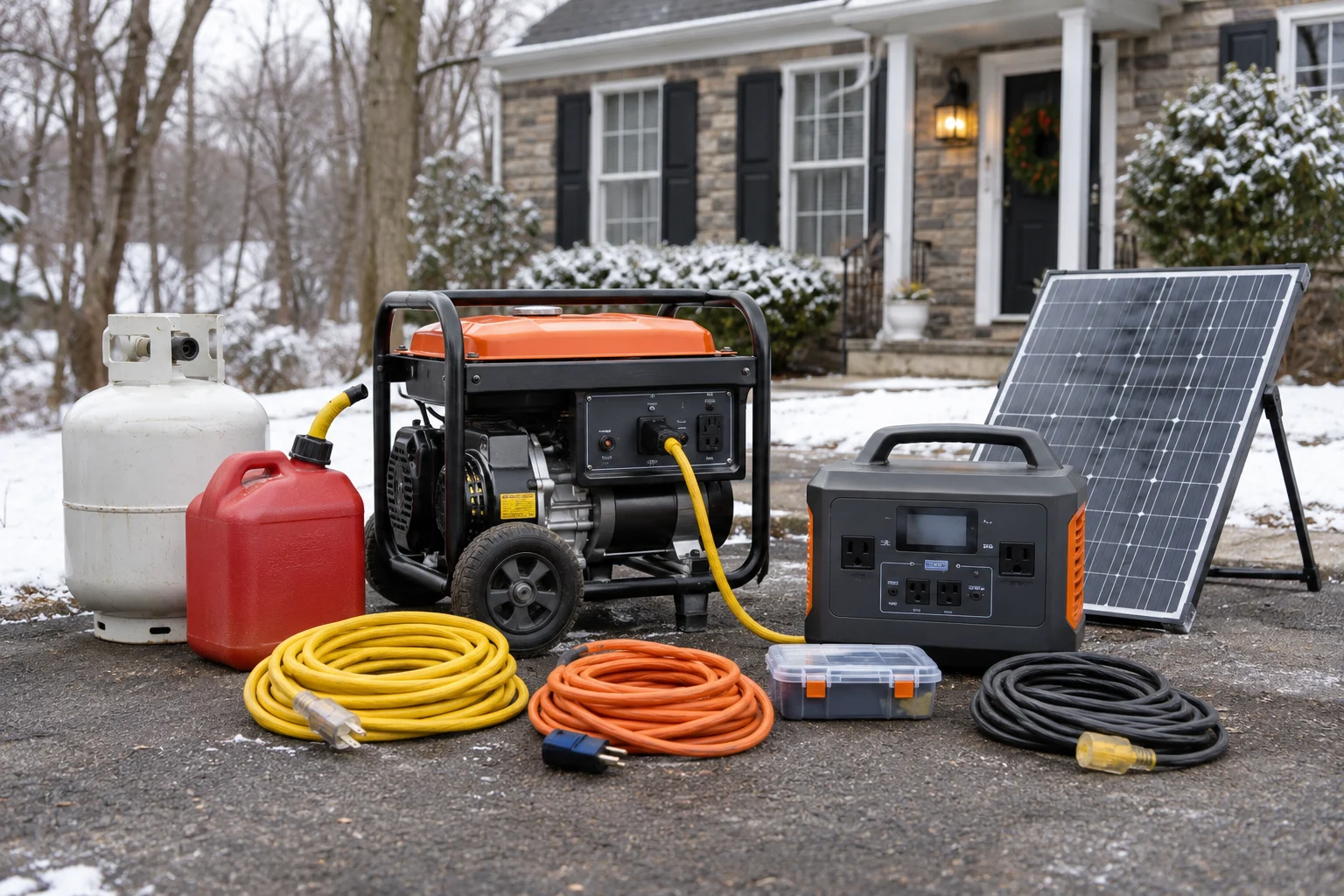
A hybrid setup combines a smaller portable power station with a fuel-powered generator.
This allows homeowners to use stored battery electricity indoors while operating the generator outdoors when additional charging is necessary.
For example:
A homeowner could use a portable battery to power lights and charge phones overnight.
During the day, they could operate a small generator outdoors to recharge the battery and support other essential appliances.
If compatible solar panels are included, those panels could provide another charging option when sunlight is available.
Example Budget: Hybrid Backup Setup
| Equipment | Estimated Cost |
|---|---|
| Small dual-fuel inverter generator | $550 |
| Portable power station, approximately 500 Wh | $300 |
| Compatible portable solar panel, approximately 100 W | $150 |
| Propane cylinder and initial fuel | $70 |
| Properly rated extension cords and solar cables | $120 |
| Generator weather protection | $120 |
| Battery-powered carbon monoxide alarms | $50 |
| Emergency lighting and backup accessories | $70 |
| Contingency allowance | $70 |
| Estimated Total | $1,500 |
This is a target budget, not a verified product bundle. It assumes compatible equipment is available at the listed prices. Additional fuel, replacement supplies, or equipment upgrades could push the total above $1,500.
This approach offers flexibility, but it also introduces more equipment and connections.
Homeowners must verify that their power station can safely recharge from their selected generator and solar panel.
They should also understand the charging limitations, electrical loads, and operating instructions for each component.
More equipment does not automatically mean a better backup system. Compatibility and preparation matter just as much.
6. Don't Forget Extension Cords, Cables, and Accessories
One of the most common mistakes homeowners make is spending their entire emergency budget on a generator or battery without considering how they will connect everything.
A generator positioned safely outdoors may require a long extension cord to reach a refrigerator inside the home.
Portable solar panels may need additional cable length to reach an area with adequate sunlight.
And the cords already sitting in your garage may not be suitable for either application.
Before purchasing equipment, consider:
- How far the generator must be positioned from the home.
- How far essential appliances are from available power connections.
- Whether extension cords can safely support the expected electrical loads.
- Whether solar panels require longer DC cables.
- Whether connectors are compatible with your equipment.
- Whether you have backup charging cables and essential accessories.
Longer electrical cords can require larger conductors to limit voltage drop and prevent unsafe operation.
Remember that American Wire Gauge (AWG) numbers work in reverse: a 12 AWG conductor is thicker than a 14 AWG conductor.
However, wire gauge alone does not determine whether a cord is appropriate. Length, current, insulation rating, environment, connectors, and equipment instructions also matter.
Avoid damaged cords, overloaded power strips, and daisy-chained extension cords.
Do not assume that an old household extension cord is suitable for generator operation.
Part 2 of this series will explain how to select, inspect, route, and test extension cords and solar cables before an outage.
7. Use AI to Help Calculate Your Backup Power Needs
Not sure how much electricity your appliances consume?
Tools such as ChatGPT or Claude can help homeowners organize appliance information and estimate backup electricity requirements.
Start by collecting the manufacturer and model number of each appliance you want to operate.
Then find its rated wattage, typical energy consumption, and startup requirements when applicable.
You can use the following prompt:
Copy-and-Paste AI Prompt
"I'm preparing for a power outage lasting seven days or longer.
My total emergency backup equipment budget is $1,500, including power equipment, extension cords, charging cables, fuel, and safety accessories.
I want to power the following appliances:
[INSERT APPLIANCE NAMES, MANUFACTURERS, MODEL NUMBERS, AND WATTAGE INFORMATION]
I expect to operate each appliance for the following number of hours per day:
[INSERT EXPECTED DAILY USAGE]
Please help me:
- Estimate my total daily electricity consumption in watt-hours.
- Identify appliances with high startup or continuous electrical loads.
- Estimate the portable battery capacity needed.
- Estimate an appropriate generator running-watt and surge-watt rating.
- Compare battery-only, generator-only, and hybrid backup options.
- Estimate solar charging requirements using conservative winter sunlight assumptions for Maryland, DC, and Northern Virginia.
- Identify equipment specifications I need to verify before purchasing.
- Develop an illustrative equipment budget under $1,500, including safety accessories.
Clearly identify any assumptions, missing information, and limitations. Do not invent appliance specifications or claim that equipment is compatible without manufacturer documentation."
Important Reminder
AI can help with planning and calculations, but it can make mistakes.
Always verify appliance specifications, electrical ratings, solar input limits, and equipment compatibility using manufacturer documentation.
For electrical installations or questions involving household wiring, consult a qualified electrician.
8. Practice Before You Need Your Equipment
Imagine losing electricity at 2 a.m. during a winter storm.
You retrieve your new generator, extension cords, and portable solar equipment, only to discover:
- Your extension cord is too short.
- Your refrigerator is difficult to move.
- The refrigerator's water line could be damaged when moving it.
- Your solar panel connectors don't match your power station.
- You don't know how to safely position the generator.
- Your battery isn't charged.
- You've never tested the system with your actual appliances.
These are problems you want to discover before an emergency, not during one.
Purchasing backup power equipment is only the first step. Knowing how to use it safely is what makes you prepared.
Before an outage, homeowners should practice setting up their equipment, connecting essential appliances, measuring electrical consumption, and verifying that everything operates as expected.
They should also establish safe equipment locations and cable routes.
A properly planned practice session can reveal missing accessories, incompatible connections, and other problems that might otherwise become serious issues during an outage.
We'll walk through that process in Part 2.
9. So, Can You Really Prepare for Seven Days Without Power for Under $1,500?
Yes, but preparation and continuous electricity supply are not the same thing.
A $1,500 budget can help homeowners build a useful emergency backup system for selected essential loads.
It generally will not provide enough stored electricity to operate an entire household continuously for seven days.
Your actual capabilities will depend on:
- Which appliances you need.
- How much electricity they consume.
- Your battery capacity.
- Generator fuel availability.
- Solar charging opportunities.
- Weather conditions.
- How carefully you manage electricity consumption.
For some households, a small dual-fuel generator may provide the most practical starting point.
Others may prefer a portable battery and solar panels.
A hybrid setup may offer additional flexibility when properly planned.
The best backup system isn't necessarily the most expensive. It's the one that safely supports your essential needs, fits your budget, and is ready when you need it.
Continue Reading: EDGE Energy's Emergency Preparedness Series
This article is Part 1 of our three-part guide to preparing for an extended power outage.
Part 2: Before the Power Goes Out: How to Prepare, Connect, and Test Your Backup Equipment
Learn how to properly size extension cords, understand solar panel connections, maintain equipment, and practice using your backup system before an emergency.
READ PART 2: PREPARING YOUR BACKUP EQUIPMENT
Part 3: When the Power Goes Out: How to Safely Operate Your Backup Power for 7+ Days
Learn how to operate generators safely, prevent carbon monoxide hazards, conserve electricity, and manage your backup equipment during an extended outage.
READ PART 3: OUTAGE SAFETY GUIDE
Preparedness Starts Before the Power Goes Out
At EDGE Energy, we've spent more than two decades helping homeowners throughout Maryland, DC, and Northern Virginia better understand their homes' energy needs.
Whether you're considering a small portable generator, solar-powered battery, or a more comprehensive backup power solution, understanding your electricity consumption and preparing ahead of time can make a meaningful difference.
A little planning today can help you avoid expensive mistakes and dangerous situations when the power goes out.

Garrett Spangler writes about home energy, electrification, and the renewable industry for The EDGE Journal.
Questions about this article?
Fill out the form and our team will get back to you shortly.