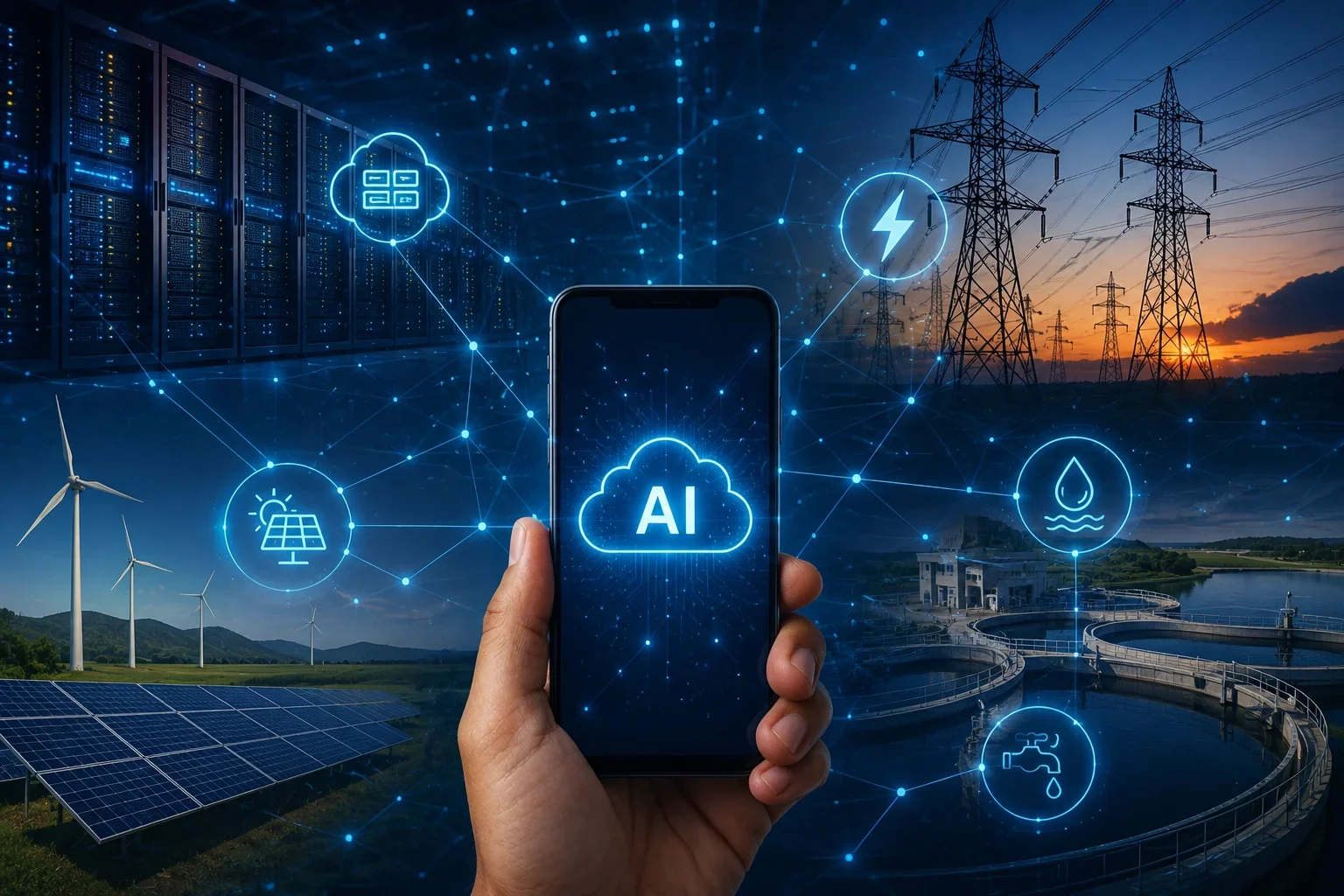
Over the past few months, headlines have circulated claiming that a simple AI-generated email may consume as much fresh water as a glass of drinking water somewhere within the data center infrastructure that powers artificial intelligence.
The exact amount depends on the technology, location, weather, and cooling systems involved. But whether the number is one ounce or one glass, the broader point remains true:
Our digital lives have a physical footprint.
Every AI query, video stream, cloud backup, and internet search ultimately runs on servers housed in data centers that require both electricity and cooling.
And nowhere is that discussion more relevant than here in Virginia, Maryland, and Washington, DC.
The World’s Largest Data Center Region Is Right in Our Backyard
Northern Virginia is widely recognized as the largest concentration of data centers on the planet. Industry estimates suggest that a significant portion of the world’s internet traffic passes through facilities located in Loudoun County and neighboring jurisdictions.
As artificial intelligence accelerates demand for computing power, local governments, utilities, and environmental regulators are paying increasing attention not only to electricity consumption but also to water use.
Historically, many large data centers relied on municipal drinking water for cooling. Today, policymakers are asking tougher questions:
- How much water should these facilities consume?
- Should drinking water be used for cooling?
- Can reclaimed or recycled water be used instead?
- What happens to cooling water after it leaves the facility?
- How can communities balance economic development with infrastructure demands?
Virginia and Maryland Are Responding
Across the Mid-Atlantic, regulators and local governments are beginning to require more transparency and accountability around data center water use.
Recent legislative and regulatory efforts have focused on:
Increased Water Use Transparency
Virginia lawmakers recently approved measures requiring greater disclosure of water consumption associated with large data center developments. Utilities, developers, and local governments are increasingly expected to provide better information regarding projected and actual water demand.
This marks a significant shift from just a few years ago when data center water use was often difficult for the public to evaluate.
Reclaimed Water and Alternative Sources
Several jurisdictions are exploring or incentivizing the use of reclaimed wastewater and other non-potable sources for cooling operations rather than relying exclusively on treated drinking water.
The goal is simple: preserve high-quality drinking water supplies for residents while supporting continued economic growth.
Tighter Environmental Oversight
Cooling systems that discharge water back into the environment face increasing scrutiny regarding temperature, chemical treatment residuals, and potential impacts on local waterways.
State environmental agencies are requiring more monitoring, reporting, and permitting oversight as facilities grow larger and more numerous.
Stricter Local Development Standards
In Maryland, several counties have proposed or adopted zoning and performance standards that evaluate data centers based on energy efficiency, water efficiency, noise impacts, and overall community infrastructure demands.
The era of simply approving large projects without examining resource consumption appears to be ending.
The Surprising Tradeoff: Water Versus Electricity
One of the most interesting challenges facing data centers is that reducing water consumption can sometimes increase electricity consumption.
For example:
- Air-cooled systems use little or no water but often require more electricity.
- Evaporative cooling systems can dramatically reduce electrical demand but consume more water.
- Hybrid systems attempt to balance both depending on weather conditions.
In the Mid-Atlantic climate, many facilities can take advantage of cooler temperatures during large portions of the year, allowing them to reduce both water and energy consumption through “free cooling” strategies that utilize outdoor air.
This same engineering principle appears throughout the building industry—including residential homes.
What Does This Have to Do With Your House?
Quite a bit, actually.
The lesson from data centers is the same lesson homeowners have faced for decades:
The cheapest unit of energy or water is the one you never have to use.
Before investing in bigger equipment, better technology, or renewable energy systems, the smartest strategy is almost always reducing waste.
For homeowners, that means:
- Air sealing leaks in the building envelope.
- Improving insulation levels.
- Installing high-efficiency heat pumps.
- Upgrading water heating equipment.
- Reducing unnecessary energy consumption.
- Managing peak electrical demand.
Every kilowatt-hour saved inside your home reduces strain on the electrical grid. Every gallon conserved reduces demand on municipal infrastructure.
The same principles that help optimize billion-dollar data centers are often the same principles that lower utility bills in a Maryland, Virginia, or DC home.
Efficiency Is Still the First Fuel
Artificial intelligence, cloud computing, and data centers are likely to remain part of everyday life for decades to come.
As these technologies grow, discussions about electricity, water use, and infrastructure will become increasingly important across our region.
Fortunately, the answer is not choosing between technology and sustainability.
The answer is better engineering.
Whether we’re talking about one of the world’s largest AI data centers or a family home in Maryland, Virginia, or Washington, DC, the principle remains the same:
Use less. Waste less. Build smarter.
That’s a philosophy we’ve been helping homeowners implement for nearly twenty years.

Garrett Spangler writes about home energy, electrification, and the renewable industry for The EDGE Journal.
Questions about this article?
Fill out the form and our team will get back to you shortly.