Part 3 of EDGE Energy's Three-Part Emergency Preparedness Series
When the electricity goes out, the backup equipment you've purchased and practiced using becomes your lifeline. But operating a generator, portable battery, or solar panel system safely during an extended outage requires more than simply plugging everything in.
A power outage lasting several hours is inconvenient. An outage lasting seven days or longer can create serious challenges for homeowners throughout Maryland, Washington, DC, and Northern Virginia.
Refrigeration, heating, communication, lighting, and essential household equipment can all be affected.
In the first two articles of our emergency preparedness series, we explained how to build an affordable backup power system and how to prepare and test your equipment before an emergency.
Now it's time to put that preparation into practice.
The goal isn't to power everything in your home. It's to safely manage the electricity you have, protect your essential needs, and make your backup resources last as long as possible.
1. The First Hour: Assess the Situation Before Starting Your Equipment
When the power goes out, don't immediately start connecting every appliance to your generator or battery.
First, determine whether the outage affects only your home or the surrounding area.
Check your utility provider's outage reporting system, if available, and monitor local emergency alerts.
If you see downed power lines, stay away and report them to your utility provider or emergency services.
Never approach or attempt to move a downed electrical line.
Prioritize Your Essential Electricity Needs
Review the appliance list and electricity calculations you developed in Part 1: How to Prepare for a 7+ Day Power Outage for Under $1,500.
For most households, priorities include:
- Refrigerators and freezers.
- Phones and emergency communication devices.
- Essential medical equipment.
- LED lighting.
- Internet equipment, if service remains available.
- Other critical household devices.
Avoid immediately connecting unnecessary appliances.
A small generator or portable battery has limited output, and connecting too many devices can cause overloads or rapidly deplete stored electricity.
Start with your most important needs and add equipment only when you've confirmed your backup system can safely support it.
2. Portable Generator Safety: Placement Matters
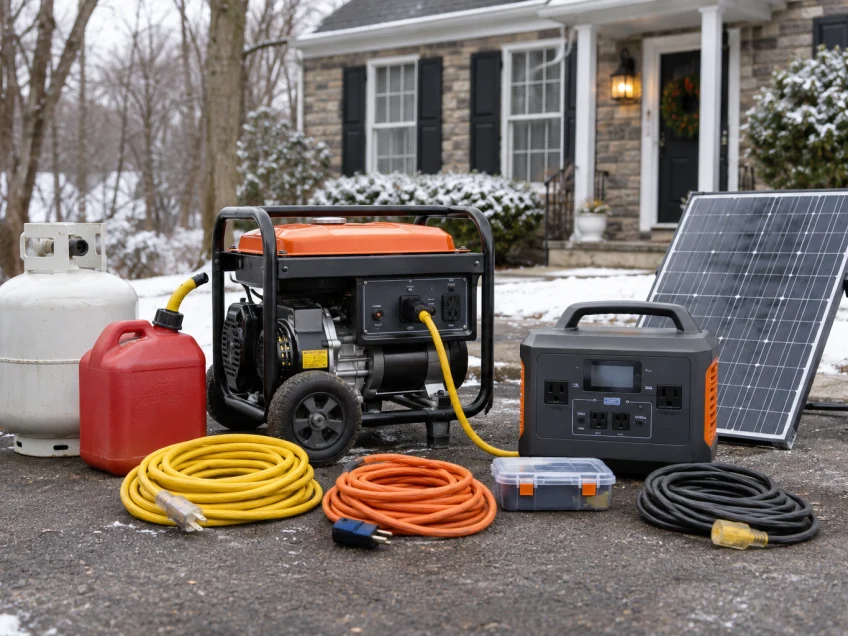
Gasoline, propane, and dual-fuel generators can provide valuable backup electricity during an extended outage.
However, they also introduce serious safety risks.
The most important is carbon monoxide poisoning.
Never Operate a Fuel-Powered Generator Indoors
Gasoline and propane generators produce carbon monoxide, a colorless, odorless gas that can be deadly.
Never operate a portable fuel-powered generator:
- Inside your home.
- Inside an attached or detached garage.
- In a basement.
- Inside a shed.
- In an enclosed porch.
- In any enclosed or partially enclosed space.
Opening garage doors or windows does not make indoor generator operation safe.
Keep Generators Away From Your Home
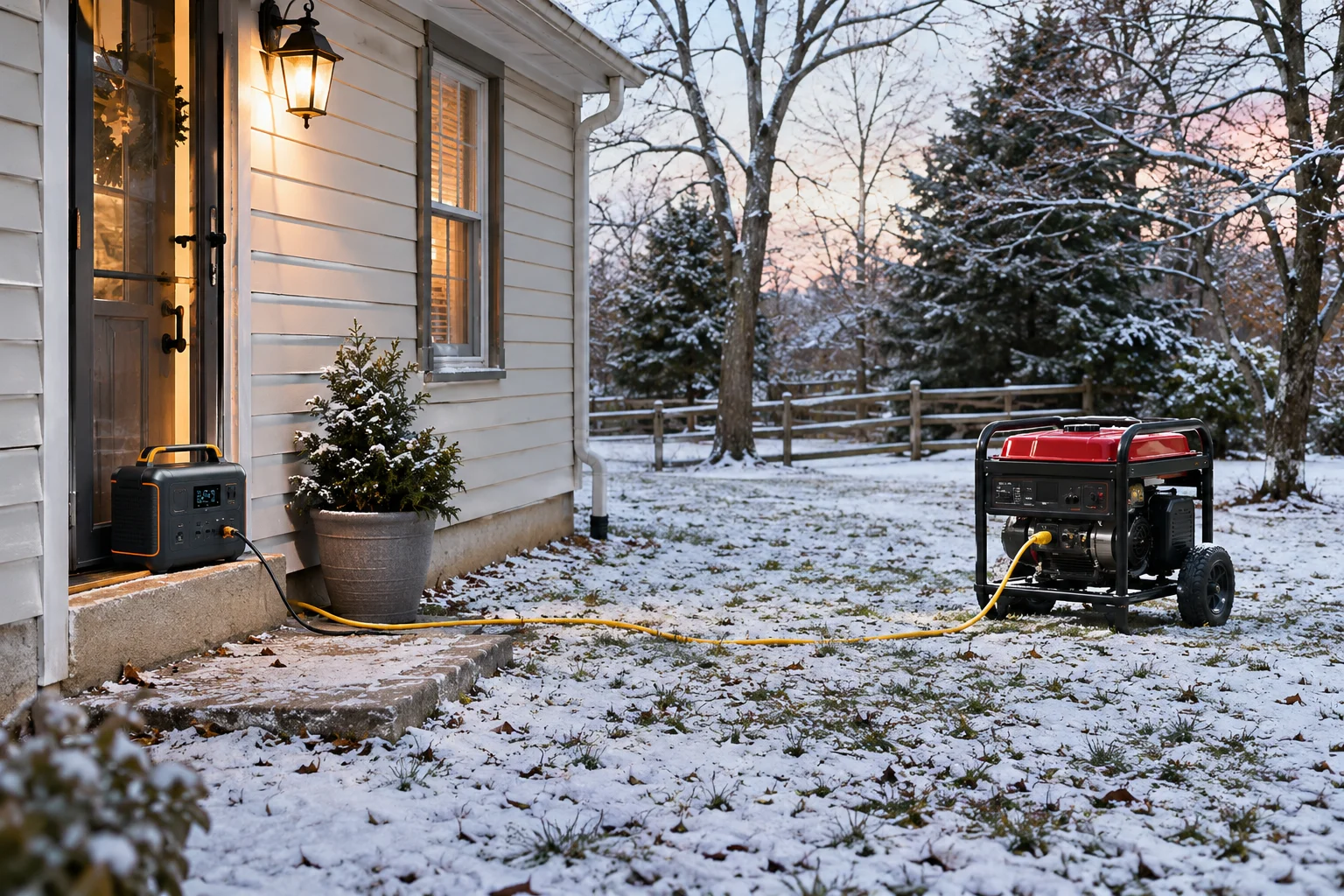
The U.S. Consumer Product Safety Commission recommends operating portable generators outdoors, at least 20 feet from the home, with exhaust directed away from windows, doors, vents, and other openings.
Follow any additional manufacturer clearance requirements.
Before starting your generator, verify that:
- It is positioned on a stable, level surface.
- Exhaust is directed away from buildings.
- Nearby windows and doors are closed.
- Air intakes and vents are unobstructed.
- The generator is not exposed to standing water.
- Carbon monoxide alarms are installed and functioning.
Remember that carbon monoxide can enter neighboring homes as well.
Position the generator with nearby buildings and outdoor conditions in mind.
Never sacrifice safe generator placement just to make an extension cord reach an appliance.
3. Operating Generators During Rain, Snow, and Winter Weather
Extended outages frequently occur during severe weather.
Unfortunately, rain and snow can make generator operation more complicated.
Portable generators contain electrical components that can create shock and electrocution hazards when exposed to moisture.
At the same time, generators require adequate ventilation and cooling.
Should You Purchase a Generator Tent or Running Cover?
Some manufacturers offer weather-protection systems specifically designed for operating compatible portable generators.
These may help protect equipment from rain or snow while maintaining the ventilation required for safe operation.
Depending on the generator and product, these accessories may cost approximately $100 to $200.
However, not every generator cover is safe to use while the generator is running.
Before purchasing or using one:
- Confirm that the cover is explicitly approved for operation with your generator model.
- Follow the generator and cover manufacturers' instructions.
- Verify that exhaust and cooling airflow remain unobstructed.
- Maintain all required clearances.
- Never allow snow or debris to block ventilation.
- Do not operate the generator if conditions cannot be made safe.
Never Improvise an Enclosure
Do not place a running generator beneath an ordinary tarp, inside a camping tent, or within a homemade enclosure.
These arrangements can trap exhaust, obstruct cooling, create fire hazards, or expose electrical components to moisture.
A weather cover also does not make it safe to operate a generator inside a garage or closer to your home.
If you cannot operate your generator safely in the existing weather conditions, do not run it. Use an alternative backup power source or relocate to a safer location.
This is one reason portable batteries can be valuable as part of an emergency backup plan.
They can provide limited indoor electricity without requiring a combustion engine to operate continuously.
4. Extension Cord Safety During an Outage
In Part 2: How to Prepare, Connect, and Test Your Backup Equipment, we explained how extension cord length, wire gauge, and electrical load affect safe operation.
During an actual outage, those preparations become especially important.
Use the Correct Extension Cords
Only use extension cords that are properly rated for the connected equipment and operating environment.
For generator applications, cords should be:
- Appropriately rated for the voltage and current.
- Suitable for outdoor use where exposed to outdoor conditions.
- Equipped with the correct grounding configuration.
- Free of damage or deterioration.
- Long enough to reach appliances without unsafe connections.
Follow the generator and appliance manufacturers' instructions.
Don't Overload Your Generator or Cords
Every generator has a maximum electrical output.
Each outlet also has its own electrical rating.
And every extension cord has a maximum permitted load.
All three limits matter.
For example, consider a homeowner operating:
| Appliance | Illustrative Running Wattage |
|---|---|
| Refrigerator | 200 W |
| Freezer | 150 W |
| Wi-Fi router | 20 W |
| LED lighting | 30 W |
| Combined Running Load | 400 W |
Although the combined running load is approximately 400 watts, the refrigerator and freezer may require additional startup power.
If both compressors start at the same time, the temporary electrical demand could be substantially higher.
Always account for startup surges and the generator's rated output on the fuel being used.
Avoid Dangerous Cord Connections
Never:
- Daisy-chain extension cords.
- Connect multiple high-current appliances to an ordinary power strip.
- Use damaged or undersized cords.
- Run cords through standing water.
- Pinch cords beneath doors or windows.
- Cover cords with rugs or carpeting.
- Use improvised electrical adapters.
Never Backfeed Your Home
Do not connect a generator to a household receptacle to supply electricity to your home's wiring.
This dangerous practice, commonly called backfeeding, can energize circuits unexpectedly and endanger utility workers, occupants, and equipment.
If you want a generator to supply household circuits, have a qualified electrician install appropriate, code-compliant transfer equipment.
For a budget portable generator setup, the simplest approach is often to connect compatible essential appliances directly using properly rated cords, following manufacturer instructions.
5. How to Make Your Battery Power Last Longer
Portable power stations are convenient because they can operate indoors without producing combustion exhaust.
However, their stored energy is limited.
A 1,000-watt-hour battery does not provide unlimited electricity, and it may deliver less than 1,000 Wh through its AC outlets because of conversion losses.
Prioritize Low-Energy Devices
Use battery power primarily for essential devices that consume relatively little electricity.
Examples include:
- Phones.
- LED lights.
- Emergency radios.
- Laptops.
- Internet equipment.
- Selected medical devices, when the system is appropriately sized.
Avoid using small portable batteries for electric space heaters, electric cooking appliances, or other high-demand equipment unless the system is specifically designed and sized for those loads.
Understand Battery Runtime
A simplified calculation is:
Battery Capacity (Wh) ÷ Appliance Power (W) = Theoretical Runtime (Hours)
For example:
A 1,000 Wh battery powering a continuous 100-watt load has a theoretical runtime of:
1,000 ÷ 100 = 10 hours
Actual runtime will generally be shorter because of inverter losses, battery operating limits, and other factors.
Reduce Unnecessary Consumption
To extend battery runtime:
- Turn off devices when they aren't needed.
- Use LED lighting instead of inefficient lighting.
- Charge phones and small electronics only as necessary.
- Avoid leaving unnecessary appliances connected.
- Use energy-saving settings where available.
- Monitor battery capacity regularly.
Some portable power stations also consume electricity simply by keeping their AC inverter active.
Turning off unused outputs may reduce standby consumption.
During a prolonged outage, small energy savings can add up significantly over several days.
6. Using Solar Panels to Recharge During an Outage
Portable solar panels can help replenish battery capacity without consuming fuel.
However, their effectiveness depends heavily on weather conditions.
As discussed in Part 2, solar panel orientation, shading, cable length, and electrical compatibility all affect charging performance.
Follow the Sun
Position portable panels in a safe location with adequate sunlight.
In the DMV, winter sunlight generally follows a lower path across the southern sky.
That means trees, buildings, and other obstacles may create more shading than homeowners experience during summer.
When practical and safe, adjust panel positioning throughout the day to improve sunlight exposure.
Expect Reduced Charging During Poor Weather
A portable solar panel rated for 200 watts may produce considerably less electricity during cloudy conditions.
Snow accumulation, shading, and poor panel orientation can further reduce output.
Homeowners should not assume that portable solar panels will fully recharge their batteries every day.
If your daily electricity consumption exceeds your daily solar production, your battery will eventually run out of stored energy.
This is why realistic load calculations and a backup charging plan are important.
Never Exceed Solar Input Limits
Before connecting panels, verify that the complete configuration is compatible with your power station.
Maximum solar input voltage, current, and charging power must remain within manufacturer specifications.
Do not modify solar connections or change series and parallel configurations during an emergency unless you are qualified to do so and the configuration has been verified as safe.
If conditions are unsafe because of lightning, high winds, ice, or other severe weather, do not deploy or adjust portable panels.
7. Managing Propane and Gasoline Supplies
For homeowners using fuel-powered generators, fuel availability may determine how long backup electricity remains available.
A generator that can power your refrigerator is not particularly useful if it runs out of fuel after the first day.
Plan Fuel Consumption Before the Outage
Generator runtime varies based on:
- Generator model.
- Electrical load.
- Fuel type.
- Fuel tank or cylinder capacity.
- Operating conditions.
Consult the manufacturer's runtime specifications for your expected load.
Remember that advertised runtimes are often measured at relatively low electrical loads.
A generator operating at a higher load may consume fuel considerably faster.
Why Propane Can Be Useful for Emergency Preparedness
Dual-fuel generators offer the flexibility to operate on propane or gasoline.
For homeowners who use their generators infrequently, propane can simplify fuel storage and reduce some gasoline-related maintenance concerns.
Unlike gasoline, propane does not become stale in the same way during storage.
However, propane cylinders must be stored and handled properly.
Never store propane cylinders inside your home, basement, or attached garage.
Follow applicable storage requirements and manufacturer instructions.
Refueling Safety
Never refuel a running generator.
Shut it down and allow it to cool according to manufacturer instructions before adding gasoline or changing fuel connections.
Keep fuel away from ignition sources.
For propane systems, inspect hoses, regulators, and connections as directed by the manufacturer.
Never use a flame to check for propane leaks.
A seven-day outage requires a realistic fuel plan, not just a generator with an advertised long runtime.
8. Using a Hybrid Battery and Generator System
In Part 1, we discussed a hybrid setup combining a smaller portable battery with a fuel-powered generator.
This approach can provide additional flexibility during an extended outage.
For example, a homeowner might:
During the Day
Operate a small generator outdoors to power compatible essential appliances and recharge a portable battery.
During the Evening
Shut down the generator and use the portable battery indoors for lighting, phones, and other low-demand devices.
During Sunny Conditions
Use compatible portable solar panels to supplement battery charging.
This approach can reduce the need to operate a fuel-powered generator continuously.
However, actual fuel savings depend on generator efficiency, charging rates, battery capacity, and household electrical loads.
Important Compatibility Considerations
Not every portable power station can safely recharge from every generator.
Some require specific input voltage, frequency, grounding characteristics, or charging settings.
Before connecting equipment, confirm compatibility using manufacturer documentation.
Do not assume that a generator and battery are compatible simply because their plugs fit together.
Never operate a fuel-powered generator indoors while charging a battery.
The generator must remain in a safe outdoor location throughout operation.
9. Protect Your Refrigerated Food and Medications
Food preservation is one of the most common reasons homeowners purchase emergency backup power.
However, refrigeration requires careful planning during an extended outage.
Keep Refrigerator and Freezer Doors Closed
According to the U.S. Food and Drug Administration, an unopened refrigerator generally keeps food cold for approximately four hours during an outage.
A full freezer may maintain safe temperatures for approximately 48 hours if unopened, while a half-full freezer may maintain temperatures for approximately 24 hours.
These are general estimates, not guarantees.
Actual temperatures depend on appliance performance, room temperature, and how frequently doors are opened.
Use Appliance Thermometers
Keep thermometers in your refrigerator and freezer.
A refrigerator should maintain a temperature of 40°F or below, while a freezer should generally remain at 0°F or below.
If you operate refrigeration intermittently using backup power, monitor temperatures carefully.
Do not assume that running a refrigerator for a short period automatically makes previously warmed food safe.
Discard perishable food when required by food safety guidance.
Refrigerated Medications
Some medications require specific temperature ranges.
If you depend on refrigerated medication, consult your pharmacist or healthcare provider about safe storage requirements and emergency procedures.
Do not assume general food refrigeration guidelines apply to medications.
10. Seven Dangerous Mistakes to Avoid During a Power Outage
Even a well-planned backup system can become dangerous if operated incorrectly.
Here are seven mistakes homeowners should avoid.
Mistake 1: Running a Generator Too Close to the Home
Carbon monoxide can enter through windows, doors, and vents.
Operate generators outdoors, at least 20 feet from the home, with exhaust directed away from openings.
Mistake 2: Operating a Generator Inside a Garage
An open garage door does not make generator operation safe.
Never operate a fuel-powered generator in a garage or other enclosed or partially enclosed area.
Mistake 3: Using Improvised Generator Weather Protection
Ordinary tarps, camping tents, and homemade enclosures can create dangerous conditions.
Use only manufacturer-approved running covers or protection methods.
Mistake 4: Overloading Extension Cords or Power Strips
Connecting too many appliances can overheat cords and electrical connections.
Verify cumulative loads and equipment ratings.
Mistake 5: Connecting a Generator Directly to Household Wiring
Never backfeed a home through an electrical receptacle.
Supplying household circuits requires properly installed transfer equipment.
Mistake 6: Assuming Solar Panels Will Fully Recharge Batteries Every Day
Clouds, shading, winter sunlight, and charging losses can significantly reduce solar production.
Monitor actual charging performance and manage electricity consumption accordingly.
Mistake 7: Waiting Until an Emergency to Learn Your Equipment
If you've never practiced connecting your refrigerator, positioning your solar panels, or starting your generator, you're more likely to encounter problems when conditions are already difficult.
Practice before an outage, and follow the procedures you've already tested.
11. Your Seven-Day Outage Safety Checklist
Keep this checklist with your emergency equipment.
Before Operating Equipment
- Check local emergency alerts and utility updates.
- Inspect equipment for visible damage.
- Verify that carbon monoxide alarms are functioning.
- Confirm generator placement and ventilation.
- Check extension cords and connections.
- Review your essential appliance priorities.
While Using Backup Power
- Monitor generator and battery electrical loads.
- Keep generators outdoors and away from openings.
- Protect equipment from unsafe weather exposure.
- Avoid overloaded cords and power strips.
- Monitor refrigerator and freezer temperatures.
- Track fuel supplies and battery capacity.
- Follow manufacturer charging and operating instructions.
Throughout the Outage
- Monitor local weather and emergency updates.
- Conserve electricity whenever practical.
- Recharge batteries when safe opportunities are available.
- Check fuel supplies before they become critically low.
- Inspect equipment for damage or abnormal operation.
- Never ignore carbon monoxide alarms or generator warning indicators.
If a carbon monoxide alarm sounds, move everyone to fresh air immediately and contact emergency services. Do not reenter until emergency responders determine it is safe.
12. Preparation Makes the Difference
A power outage lasting seven days or longer can be challenging, but homeowners don't necessarily need an expensive whole-home backup system to improve their preparedness.
As we've discussed throughout this series, the most effective approach starts with three things:
1. Choose the Right Equipment
Understand your essential electricity needs and select backup equipment that fits your budget.
2. Prepare and Practice
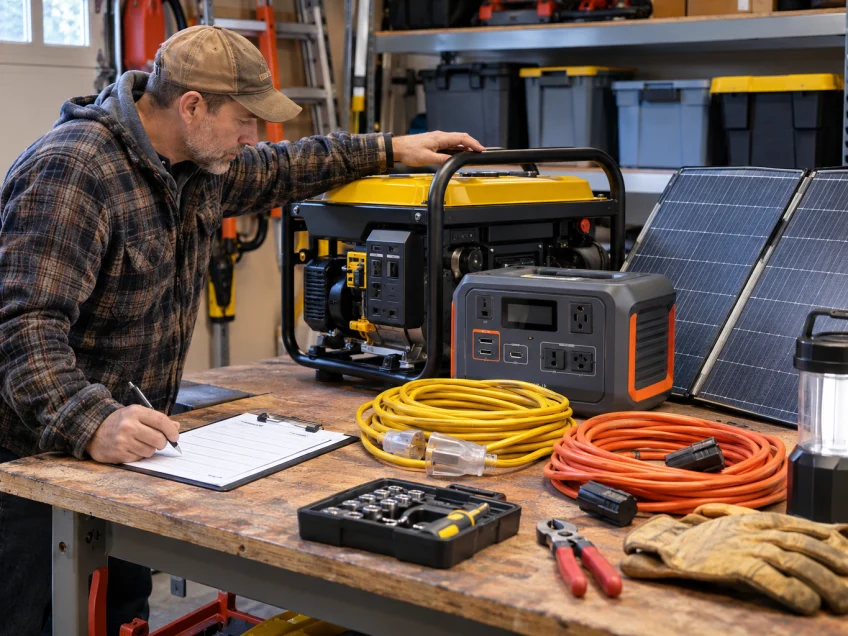
Verify equipment compatibility, inspect cables, maintain generators, and practice your setup before an emergency.
3. Operate Everything Safely
Prioritize essential loads, conserve electricity, manage fuel supplies, and follow electrical and carbon monoxide safety requirements.
A $1,500 emergency backup system won't power every appliance in your home for a week, but careful planning can help you maintain essential services and avoid dangerous situations during an extended outage.
Explore EDGE Energy's Complete Emergency Preparedness Series
Part 1: How to Prepare for a 7+ Day Power Outage for Under $1,500
Learn how to calculate electricity needs, compare portable generators and batteries, and develop a realistic emergency preparedness budget.
READ PART 1: BUILD YOUR BACKUP POWER PLAN
Part 2: Before the Power Goes Out: How to Prepare, Connect, and Test Your Backup Equipment
Learn how to properly size extension cords, connect solar panels, maintain equipment, and practice your backup power setup.
READ PART 2: PREPARE YOUR BACKUP EQUIPMENT
EDGE Energy: Helping Homeowners Prepare
For more than 20 years, EDGE Energy has helped homeowners throughout Maryland, Washington, DC, and Northern Virginia better understand their electrical systems, energy consumption, and home energy options.
Whether you're considering portable backup equipment, solar technology, battery storage, or electrical improvements, preparation and safe operation are essential.
The best emergency power system is one you understand, have practiced using, and can operate safely when you need it most.

Garrett Spangler writes about home energy, electrification, and the renewable industry for The EDGE Journal.
Questions about this article?
Fill out the form and our team will get back to you shortly.