Part 2 of EDGE Energy's Three-Part Emergency Preparedness Series
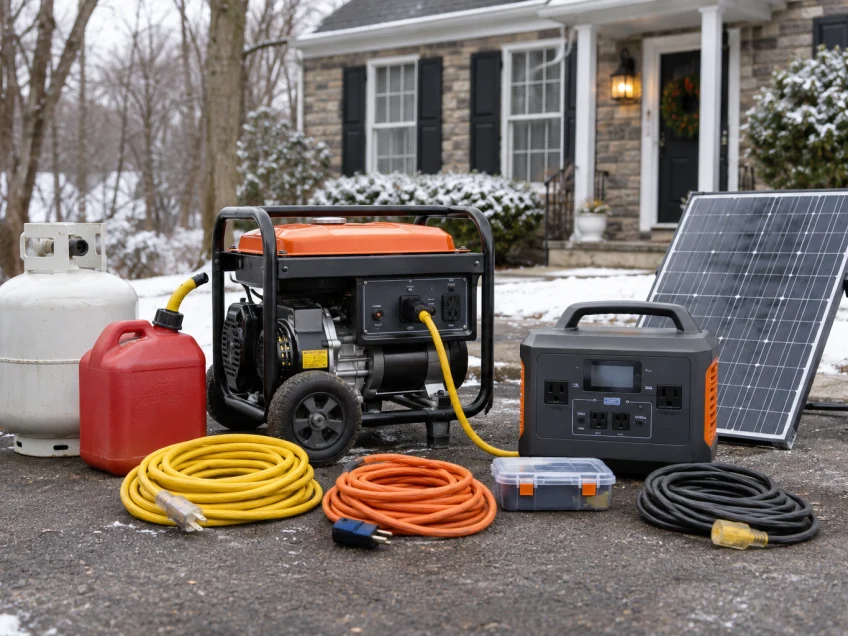
Buying a generator, portable battery, or solar panels is only the first step toward preparing for an extended power outage. Knowing how to connect, maintain, and safely operate that equipment before an emergency is what makes your backup power plan reliable.
In Part 1: How to Prepare for a 7+ Day Power Outage for Under $1,500, we discussed affordable backup power options, how to calculate your essential electricity needs, and how to choose between portable batteries, solar generators, and fuel-powered generators.
But purchasing the right equipment is only half the battle.
Imagine losing electricity at 2 a.m. during a winter storm. You pull out your generator, extension cords, and portable solar panels, only to discover that your cables aren't long enough, your solar connectors don't match, or you can't safely reach your refrigerator.
The middle of a power outage is not the time to figure out how your equipment works.
Here's how to prepare, connect, and test your backup power system before you actually need it.
1. Plan Your Backup Power Setup Before an Emergency
Start by identifying exactly where your equipment will be positioned and which appliances you intend to operate.
For example:
- Where will your generator operate safely outdoors?
- Where will your portable battery or solar generator sit inside your home?
- How far are your refrigerator, freezer, and other essential appliances from their backup power sources?
- Where will your portable solar panels receive the most sunlight?
- How will you route cables without creating tripping hazards or damaging electrical cords?
- Do you have all the necessary connectors, adapters, and accessories?
These questions might seem simple, but the answers determine whether your equipment will actually work together.
Don't Forget the Physical Logistics
Consider your refrigerator.
Many refrigerators sit tightly against the wall, with limited access to their electrical outlets.
If you plan to power yours using a portable generator or battery, you may need to move it to access the power cord.
But what happens if your refrigerator has a connected water line?
Pulling it forward too quickly could damage the water supply connection, creating a leak at the worst possible time.
Practice accessing your refrigerator's power connection before an outage. Make sure you can safely reach it without damaging plumbing, electrical connections, or flooring.
You should also determine whether your backup power cord can reach the refrigerator without being stretched, crushed, or routed through an unsafe location.
A little preparation can prevent a much bigger problem later.
2. Extension Cord Safety: Size, Length, and Electrical Load Matter
Not all extension cords are created equal.
An extension cord that works perfectly for charging a phone may be completely unsuitable for powering a refrigerator or another high-demand appliance.
Using an undersized, damaged, or overloaded extension cord can cause overheating, equipment damage, and potentially a fire.
Understanding Extension Cord Wire Gauge
Extension cords are commonly labeled using American Wire Gauge (AWG).
The lower the AWG number, the thicker the conductor.
For example:
| Wire Gauge | Relative Thickness | General Consideration |
|---|---|---|
| 16 AWG | Thinner | Often used for lighter electrical loads |
| 14 AWG | Medium | Common for moderate electrical loads |
| 12 AWG | Thicker | Often preferred for higher loads or longer cord runs |
| 10 AWG | Very thick | May be appropriate for demanding applications requiring larger conductors |
Important: This table is not a universal amperage rating. A cord's safe capacity depends on its construction, length, connectors, listing, environmental rating, and manufacturer specifications.
Why Extension Cord Length Matters
As electricity travels through a wire, some energy is lost as heat because of electrical resistance.
Longer cords have greater resistance, which can increase voltage drop.
This becomes particularly important when powering appliances with motors or other demanding electrical loads.
For example, a 100-foot extension cord may require a larger conductor than a 25-foot cord supplying the same appliance.
The longer the cord and the greater the electrical load, the more important proper wire sizing becomes.
Before purchasing an extension cord, verify:
- The appliance's running and startup requirements.
- The generator or power station's outlet rating.
- The cord's rated amperage and voltage.
- The required cord length.
- Whether the cord is rated for outdoor use.
- Whether the manufacturer permits extension cord operation.
Avoid purchasing unnecessarily long cords, but never sacrifice safe generator placement just to use a shorter cable.
Replace Old or Damaged Extension Cords
If your emergency plan relies on an extension cord that has been sitting in your garage for 15 years, inspect it carefully.
Look for:
- Cracked or damaged insulation.
- Loose or damaged plugs.
- Bent or missing grounding pins.
- Discoloration or evidence of overheating.
- Exposed wiring.
- Signs of moisture damage.
Replace cords showing any of these problems.
For emergency preparedness, investing in new, properly rated extension cords is often more sensible than relying on old cords of unknown condition.
Never Daisy-Chain Extension Cords
Connecting one extension cord to another increases the number of connections that can loosen, overheat, or become damaged.
Avoid daisy-chaining cords to reach an appliance.
Instead, purchase a single, appropriately rated cord of the required length.
Do not connect multiple high-demand appliances to a power strip at the end of an extension cord.
The total electrical load matters.
For example, a 1,500-watt space heater and a 1,000-watt appliance operating simultaneously would consume approximately 2,500 watts.
At 120 volts, that represents roughly 20.8 amps before considering startup surges or other factors.
That exceeds the rating of a typical 15-amp household receptacle.
The generator, outlet, extension cord, and connected equipment must all be capable of safely supporting the load.
3. Solar Generator Cables: Longer Runs Require More Planning
Portable solar panels can be a valuable way to recharge a battery during an extended outage.
However, homeowners need to understand that solar panel cables are different from ordinary household extension cords.
Solar panels produce direct current (DC) electricity.
Most household appliances operate on alternating current (AC).
A portable power station typically uses an internal charge controller to manage incoming solar electricity and an inverter to supply AC electricity to appliances.
Why Solar Cable Length Matters
Solar panels may need to be positioned some distance from your home to receive adequate sunlight.
For example, the best location might be 30 or 50 feet away from your portable battery.
But longer solar cables increase electrical resistance and can reduce charging efficiency.
As with household extension cords, longer cable runs may require thicker conductors.
When choosing solar extension cables, consider:
- Total cable length, including both positive and negative conductors.
- Maximum current.
- Operating voltage.
- Acceptable voltage drop.
- Cable temperature and environmental ratings.
- Connector compatibility.
- Manufacturer requirements.
Do not assume that any cable with a matching connector is suitable for your solar equipment.
The cable and connectors must be properly rated for the system's voltage, current, and operating environment.
Solar Cable Sizing Is Not the Same as Household Extension Cord Sizing
A solar panel cable may operate at a different voltage and current than a standard household extension cord.
This means the correct wire size cannot be determined by length alone.
Homeowners should follow the solar panel and power station manufacturers' specifications.
If you're uncertain about cable sizing or compatibility, consult the equipment manufacturer or a qualified electrical professional.
4. Connecting Solar Panels: Series vs. Parallel
One of the most important things to understand before connecting multiple solar panels is the difference between series and parallel configurations.
These connections affect the voltage and current delivered to your portable power station.
Series Connections
When compatible solar panels are connected in series, their voltages add together while the current remains approximately the same.
For example:
Two identical panels rated at 20 volts and 5 amps at their maximum power point would produce approximately:
40 volts × 5 amps = 200 watts
This assumes ideal operating conditions.
Parallel Connections
When compatible solar panels are connected in parallel, their currents add together while the voltage remains approximately the same.
Using the same example:
Two identical panels rated at 20 volts and 5 amps would produce approximately:
20 volts × 10 amps = 200 watts
Again, this represents ideal conditions.
Why This Matters
Portable power stations have specific solar input limitations.
These may include:
- Maximum input voltage.
- Maximum input current.
- Maximum charging wattage.
- Supported operating voltage range.
- Compatible connector types.
Connecting too many panels in series can exceed a power station's maximum input voltage and permanently damage the equipment.
Cold temperatures can increase a solar panel's open-circuit voltage, making voltage calculations particularly important during winter.
Parallel configurations also require attention to current limits, compatible connectors, and appropriate overcurrent protection where required.
Never assume that two panels can be safely connected simply because their plugs fit together.
Always verify the complete panel configuration against the power station manufacturer's specifications before connecting equipment.
If the documentation does not clearly support your intended configuration, contact the manufacturer or a qualified solar professional.
5. Practice Positioning Your Solar Panels Throughout the Day
Portable solar panels are only useful when they receive adequate sunlight.
A location that looks sunny at 9 a.m. may be shaded by trees or buildings at noon.
And a location that works well in July may receive significantly less sunlight in December.
Understand the Sun's Path
In Maryland, DC, and Northern Virginia, the sun generally follows a lower path across the southern sky during winter.
This can increase shading from nearby trees, buildings, fences, and other obstacles.
Before an outage:
- Identify locations with good southern exposure.
- Observe shading throughout the day.
- Test different panel orientations.
- Check how seasonal changes affect sunlight.
- Determine whether your solar cables can reach the best locations.
- Measure actual charging performance.
Test Solar Charging in Different Conditions
A solar panel advertised as 200 watts will not necessarily produce 200 watts during normal operation.
Cloud cover, shading, temperature, orientation, and charging limitations can reduce output.
Try testing your equipment on both sunny and cloudy days.
Record how much electricity your panels actually produce and how long they take to recharge your battery.
This will help you develop realistic expectations for an extended outage.
What About Rain, Snow, and Wind?
Not all portable solar panels are designed for the same weather conditions.
Some are rated for outdoor exposure, while others have limitations involving moisture, connectors, or prolonged exposure.
Always follow manufacturer instructions.
Never operate damaged or wet electrical connections, and do not deploy portable panels during conditions that make setup or operation unsafe.
Panels should also be secured according to manufacturer instructions so they cannot blow over or become airborne during strong winds.
The goal is to understand your equipment's capabilities before severe weather arrives, not to experiment with it during dangerous conditions.
6. Maintain Your Generator, Battery, and Emergency Equipment
Backup equipment that sits unused for months or years may not be ready when you need it.
A simple maintenance routine can prevent many common problems.
Portable Batteries and Solar Generators
Follow the manufacturer's recommendations for:
- Storage temperature.
- Battery charge level.
- Periodic recharging.
- Firmware updates, when applicable.
- Cable and connector inspection.
- Safe storage away from excessive heat and moisture.
Different battery chemistries and manufacturers have different storage requirements.
Do not assume every portable battery should remain fully charged indefinitely.
Gasoline and Dual-Fuel Generators
Portable generators require periodic maintenance, even if they are only used for emergencies.
Depending on the model, maintenance may include:
- Checking engine oil.
- Inspecting the air filter.
- Replacing spark plugs.
- Inspecting fuel connections.
- Testing startup procedures.
- Running the generator periodically.
- Following manufacturer-recommended service intervals.
For dual-fuel generators, propane operation can help avoid some gasoline-related storage and fuel-system problems.
However, running a generator exclusively on propane does not eliminate the need for maintenance.
Propane cylinders, regulators, hoses, and connections must also be inspected and maintained according to manufacturer instructions.
Never store propane cylinders indoors, in basements, or in attached garages.
Keep Essential Accessories Together
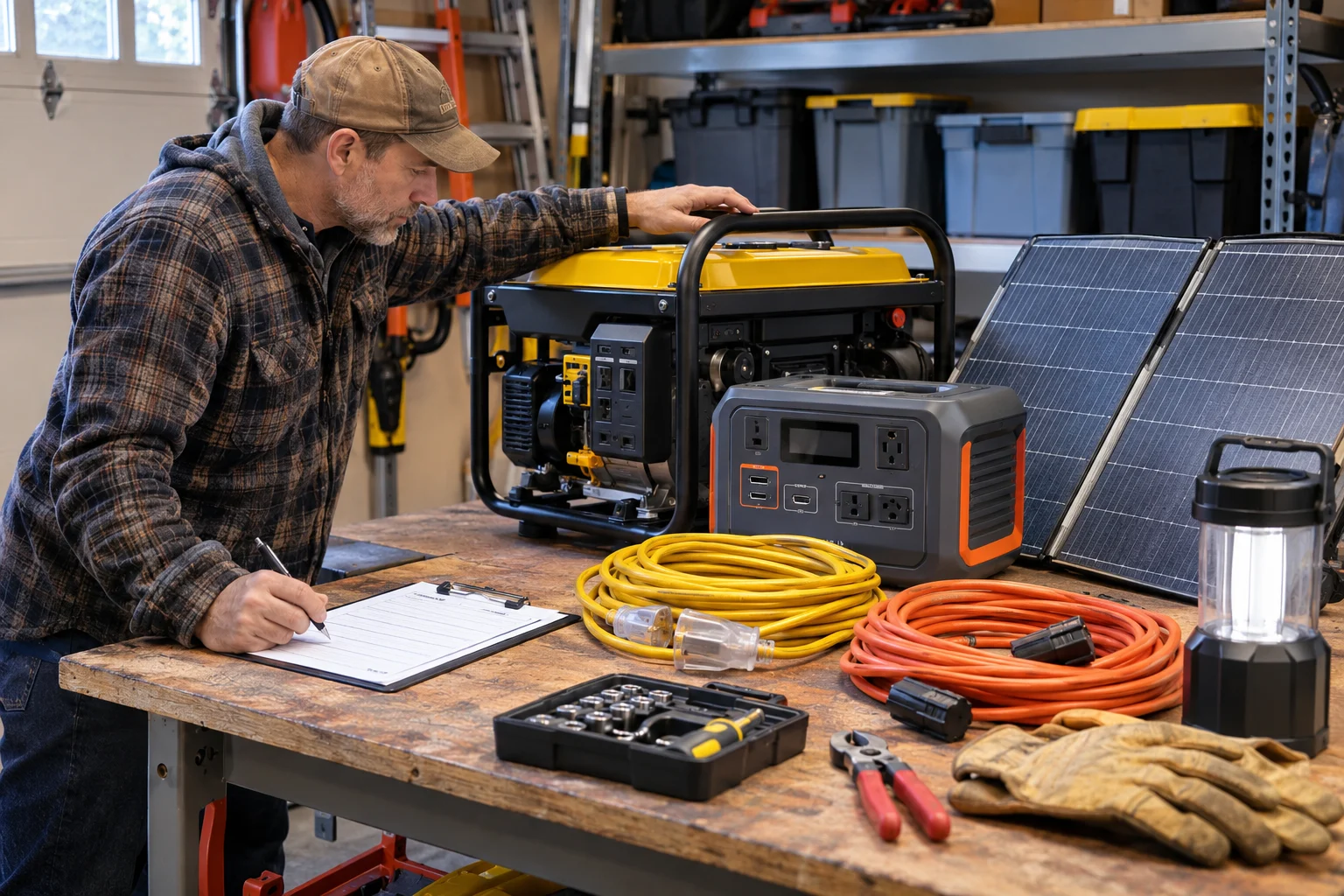
Consider organizing your backup equipment in a dedicated storage area.
Include:
- Properly rated extension cords.
- Compatible solar charging cables.
- Manufacturer-approved adapters.
- Backup charging cables.
- Flashlights and rechargeable lighting.
- Equipment manuals.
- Spare manufacturer-approved accessories.
- A written emergency setup checklist.
Avoid storing incompatible connectors or improvised adapters that could accidentally be used with the wrong equipment.
7. Conduct a Practice Power Outage Before the Real Thing
This may be the single most important recommendation in the entire series.
Don't wait until your power goes out to learn how your backup equipment works.
Choose a convenient day to test your emergency setup.
You don't need to disconnect your entire home from utility electricity. Instead, simulate the loss of power for selected essential appliances.
Step 1: Identify Your Essential Appliances
Review the equipment and electricity calculations from Part 1.
Decide which appliances you intend to operate during an outage.
Step 2: Set Up Your Backup Equipment
Position your portable battery, solar panels, or generator in their planned locations.
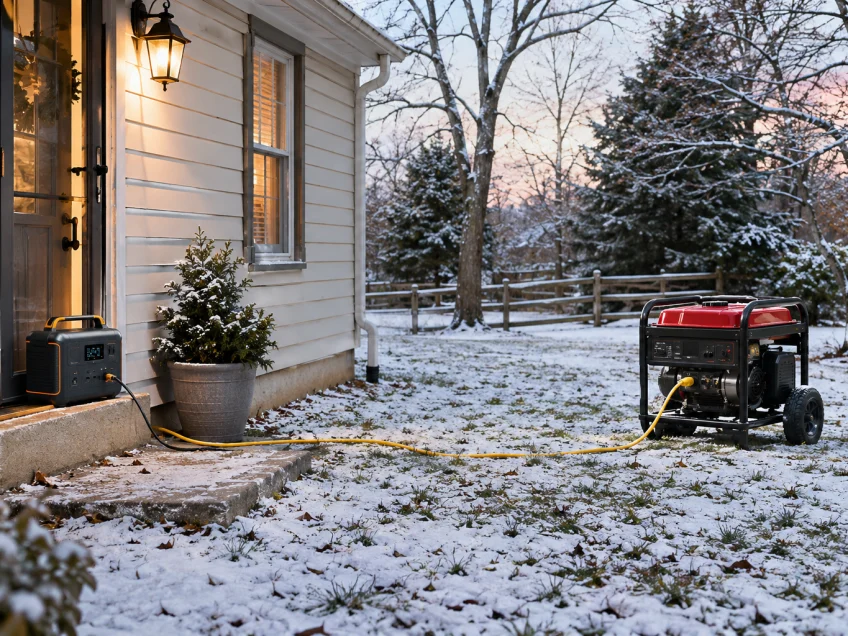
For fuel-powered generators, use a safe outdoor location at least 20 feet from the home, with exhaust directed away from openings, and follow all manufacturer requirements.
Step 3: Check Your Cable Routes
Verify that every cord reaches its intended destination without:
- Being stretched.
- Crossing unsafe walking areas.
- Being pinched by doors or windows.
- Contacting sharp edges.
- Being exposed to standing water.
- Creating unnecessary tripping hazards.
Do not route cords through closed windows or doors where they could be crushed or damaged.
Step 4: Connect and Test Your Appliances
Following manufacturer instructions, test your equipment with the appliances you intend to operate.
Verify that:
- The generator or battery supports the electrical load.
- Motor-driven appliances start successfully.
- No overload warnings appear.
- Cords and connectors remain in good condition.
- Charging equipment operates as expected.
Do not intentionally overload equipment to test its limits.
Step 5: Practice Solar Charging
If you have portable solar panels, test their placement and charging performance.
Confirm that your cables are long enough and that your power station accepts the selected panel configuration.
Step 6: Record What You Learn
Write down:
- Equipment locations.
- Cable lengths.
- Appliance power consumption.
- Battery runtime.
- Solar charging performance.
- Generator operating procedures.
- Missing accessories.
- Problems that need correction.
This information will become extremely valuable during a real emergency.
8. Your Pre-Outage Equipment Checklist
Before severe weather arrives, review the following checklist.
Backup Power Equipment
- Portable batteries are charged according to manufacturer recommendations.
- Generator maintenance is current.
- Generator startup has been tested.
- Propane or gasoline supplies are adequate for the planned operating schedule.
- Generator fuel is stored safely.
Electrical Cords and Connections
- Extension cords are properly rated for their intended loads.
- Cords are long enough to reach appliances safely.
- No damaged or undersized cords are being used.
- Solar cables and connectors are compatible.
- Backup charging cables are available.
- Electrical loads have been calculated.
Solar Equipment
- Solar panels have been tested.
- Panel configurations are compatible with the power station.
- Solar input voltage and current limits have been verified.
- Panel locations receive adequate sunlight.
- Weather limitations are understood.
Household Preparation
- Refrigerator and freezer connections are accessible.
- Appliance water lines and other connections are protected.
- Safe cable routes have been identified.
- Carbon monoxide alarms are installed and functioning.
- Equipment manuals are accessible.
- Household members understand the emergency plan.
9. Preparation Is What Makes Backup Power Useful
A portable generator, solar panel, or battery can provide valuable backup electricity during an extended outage.
But none of that equipment is particularly helpful if you don't know how to connect it, maintain it, or operate it safely.
The most effective emergency backup plans account for more than electricity production.
They consider equipment compatibility, cable lengths, appliance requirements, weather conditions, physical setup, and routine maintenance.
A successful practice run today can prevent dangerous mistakes, damaged equipment, and unnecessary frustration during a real emergency.
And remember, you don't need an expensive whole-home backup system to make meaningful preparations.
With a realistic budget, carefully selected equipment, and a little practice, homeowners can become substantially better prepared for an extended power outage.
Continue Reading: EDGE Energy's Emergency Preparedness Series
Part 1: How to Prepare for a 7+ Day Power Outage for Under $1,500
Learn how to calculate your essential electricity needs, compare backup power options, and build a practical emergency preparedness budget.
READ PART 1: BUILD YOUR BACKUP POWER PLAN
Part 3: When the Power Goes Out: How to Safely Operate Your Backup Power for 7+ Days
Learn how to safely operate portable generators, prevent carbon monoxide hazards, manage fuel supplies, conserve electricity, and use your backup equipment during an extended outage.
READ PART 3: OUTAGE SAFETY GUIDE
EDGE Energy: Helping Homeowners Prepare
For more than 20 years, EDGE Energy has helped homeowners throughout Maryland, Washington, DC, and Northern Virginia understand their homes' electrical and energy needs.
Whether you're evaluating backup power equipment, solar technology, or electrical improvements, understanding how your equipment works is an important part of protecting your home.
The best time to test your emergency backup system is before you need it.

Garrett Spangler writes about home energy, electrification, and the renewable industry for The EDGE Journal.
Questions about this article?
Fill out the form and our team will get back to you shortly.